Keystone in action
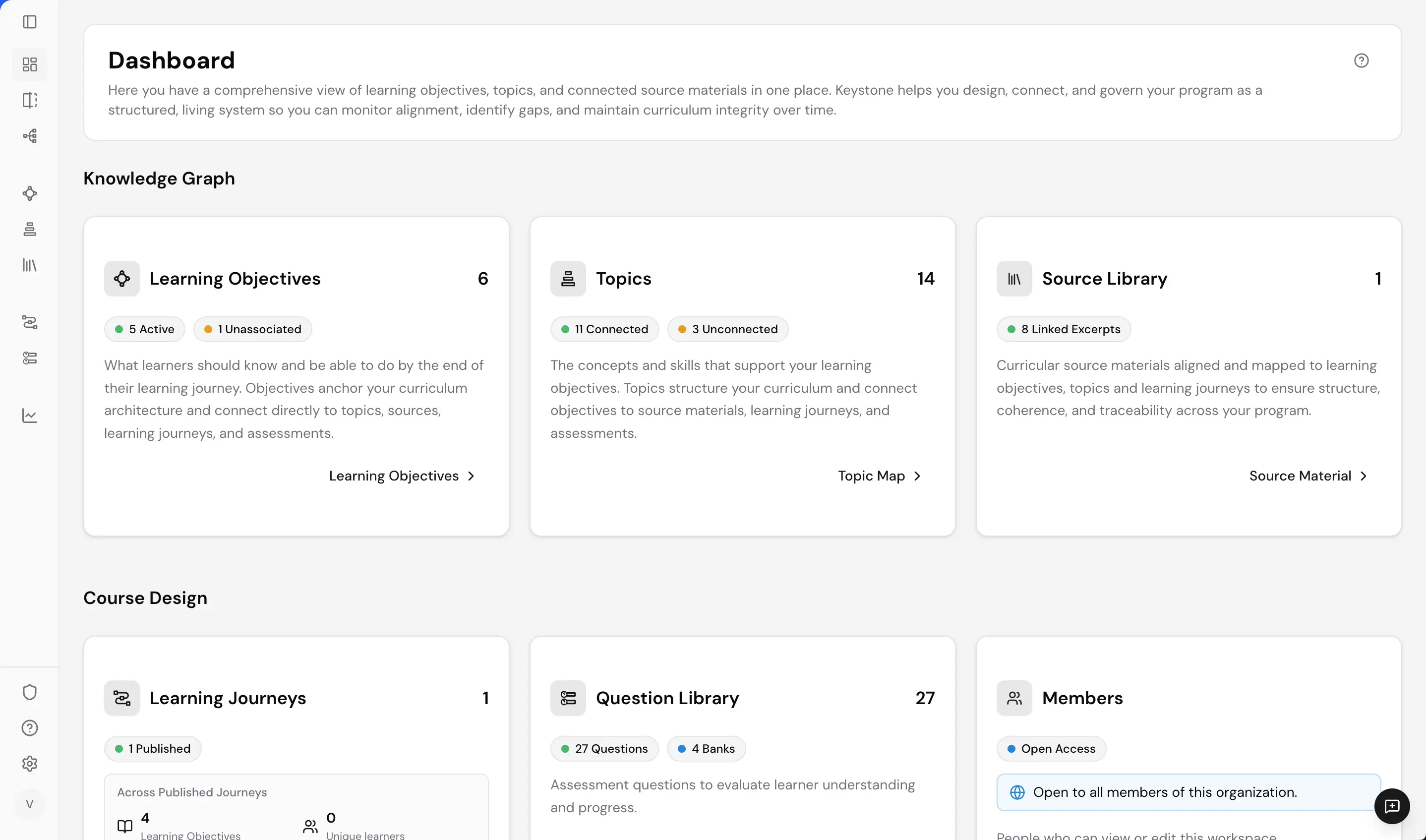
HOW KEYSTONE WORKS Build, connect, and deliver educational content.
Keystone is an educational curriculum design platform that helps you create well-structured, outcome-based learning experiences. It organizes your curriculum through three interconnected layers and provides tools to deliver content directly to learners.
Three steps from design to delivery. KEYSTONE powers the full lifecycle.
Every course in Keystone moves through a unified three-stage lifecycle, keeping objectives, learning materials, and student progress tightly synchronized.
Step 01
•
Outcome Mapping
Design
Define what learners should know with structured Learning Objectives and Bloom's taxonomy. Classify cognitive complexity from foundational recall to advanced evaluation.
Hierarchical topic trees, competency tagging, and prerequisite dependencies.
Module 1
Unit 1.1 Foundation
Article reading
Video lecture
Knowledge quiz
Step 02
•
Content Authoring
Build
Create modular learning journeys with engaging lessons, rich media, and formative checks. Assemble modules, units, and learning activities in the exact progression you intend.
Interactive skill labs, rich text articles, video embeds, and objective alignment.
Published to LMS
A
B
C
Step 03
•
Live Deployment
Deliver
Publish validated content and monitor learner mastery with live cohort analytics. Safe draft states let curriculum teams collaborate without premature student exposure.
Version-controlled publishing, LMS integration, and real-time outcome tracking.
Three connected layers that structure your curriculum.
Instead of loose documents and isolated syllabi, Keystone maps curriculum across three persistent, interconnected layers.
Outcome Layer
Learning Objectives
Define what learners should know, understand, or be able to do. Each objective is classified using Bloom's taxonomy levels to specify exact cognitive complexity.
- Bloom's Taxonomy classification
- Measurable competency criteria
- Granular outcomes mapped to lessons
Taxonomy Layer
Topics
Topics represent your subject matter taxonomy. They form a hierarchical tree from broad domains down to specific concepts, establishing clear subject coverage.
- Hierarchical domain and concept tree
- Explicit prerequisite relationships
- Elimination of subject blind spots
Evidence Layer
Sources
Your educational materials: textbooks, articles, video lectures, and lab guides. Sources are segmented into excerpts that link directly to topics.
- Textbooks, papers and video materials
- Granular excerpt-level topic links
- Direct provenance for accreditation
Building Learning Journeys.
Learning Journeys are the complete curriculum paths you deliver to learners. They combine your objectives with engaging content, organized into a clear, modular structure.
1
Create Your Outline
Build a structured hierarchy with Modules, Units, and Lessons. Attach Learning Objectives at any level to define what learners will achieve at each milestone.
Modules
→
Units
→
Lessons + Objectives
2
Add Content and Activities
Fill lessons with learning activities like structured articles, video lectures, and quizzes. Learners progress through activities in the exact order you define.
Articles
•
Videos
•
Quizzes
•
Skill Labs
3
Publish to Learners
Deploy sections when ready. Content stays in Draft until published, allowing curriculum teams and faculty to collaborate and review without learners seeing incomplete work.
Draft
→
Live Version
One graph. Every element connected.
Objectives, topics, skills, sources, journeys, assessments, outcomes, and pathways all live in a single knowledge graph. Click any node to see what it connects to and how Keystone puts it to work.
Keystone
Knowledge graph
Click any node to expand the intelligence layer
One unified curriculum engine.
Explore each core capability of Keystone in detail.
Knowledge Graph
Map topics, learning objectives, and source materials into a living relational graph.
Course Design
Build modular learning journeys, units, lessons, and activities anchored to outcomes.
Version Insights
Track course iterations across time, compare completion metrics, and trace edit impacts.
Admin Panel
Govern granular team roles, manage LMS integrations, and maintain full data privacy.
See it run with your own curriculum.
Bring a real program and we will show you how it maps, connects, and traces inside Keystone.
Three layers. One structure. Nothing to rebuild.